
WELCOME BONUS 300%
UP TO €2000 + 100
FREE SPINS
UP TO €2000 + 100
FREE SPINS
Home → Blackjack
Blackjack at Tycoon Casino
Insurance vs Even Money When You Hold Blackjack
Blackjack Insurance offered on a six to eight deck game carries an RTP of 92.53% and a house edge of 7.47%, far above the 0.46% that a six-deck, S17, DAS, DOA, 3:2 game with basic strategy produces. Insurance pays 2:1 and is a separate side bet of up to 50% of the main bet, so a €10 main bet allows a €5 insurance stake. Basic strategy always declines it, and only card counters at a true count of +3 or better should take it. On a single deck the insurance edge is about 5.88%, still far above the main game.
Even money on a natural blackjack is functionally the same wager as insurance, because the player accepts a 1:1 payout instead of risking the 3:2 win. A 3:2 blackjack pays €15 on a €10 bet, while a 6:5 payout pays only €12, so accepting 1:1 even money returns €10 and locks in €5 less than the standard 3:2 result. The 6:5 rule alone lifts the casino's edge by 1.39 percentage points, to 1.85%.
Across 100 rounds at €10 per hand, the 7.47% insurance edge costs about €74.70 in expected losses, compared with roughly €4.60 on the same stakes in the 0.46% six-deck game. A player who takes even money on every natural blackjack gives up the difference between 3:2 and 1:1 each time, and that difference is larger than the value of the insurance bet itself. The exception is the card counter, whose true count of +3 or higher can justify the 2:1 insurance payout.
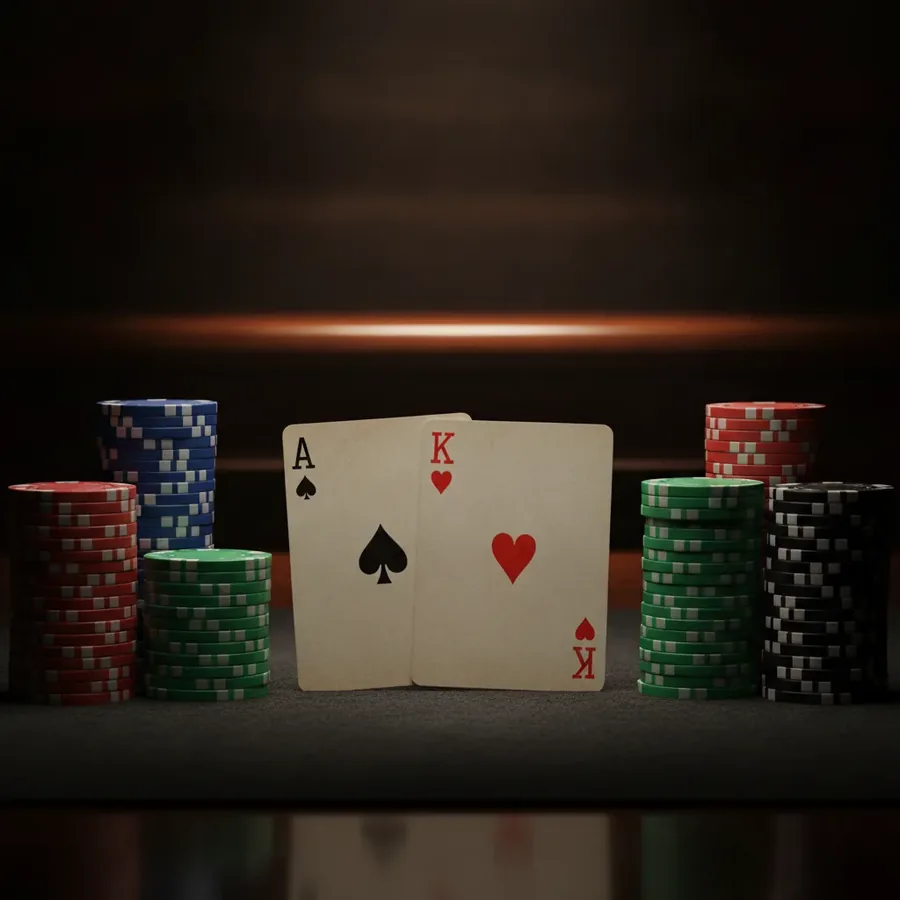
Six to Eight Decks in the Shoe
Moving from eight decks to six decks in the shoe improves the player's return by about 0.02 percentage points, a small but measurable shift in the house edge of a 3:2 blackjack game. A six-deck game with S17, DAS, DOA and a 3:2 payout returns 99.54% with a 0.46% edge, and the two-deck reduction contributes a fraction of that edge. One deck instead of eight decks is worth about 0.48 percentage points, far more than the six-to-eight change.
The deck count interacts with other rules: a 6:5 payout on a six-deck game adds 1.39 percentage points to the casino's edge and greatly outweighs the 0.02 percentage points gained from the smaller shoe. A single-deck game with classic rules and a 3:2 payout returns 99.85% with a 0.15% edge, but that figure is often erased by a 6:5 payout. A liberal Vegas Strip rule set with 3:2 reaches 99.72% and a 0.28% edge.
Over 500 rounds at €10 per hand, the 0.02 percentage point difference between six and eight decks is about €1 of expected loss, while a 6:5 payout on the same volume costs far more. The practical consequence is that a player comparing two tables should treat the deck count as a minor factor and the blackjack payout as the dominant one.
Surrender or Play On With 16 Against a 10
Late surrender lets the player give up the hand after the dealer has checked for blackjack and lose half the stake, improving the RTP by about 0.08 percentage points. A player facing a 16 against a dealer 10 can surrender and receive 50% of the stake back, or play the hand out under basic strategy. Early surrender is worth up to 0.6 percentage points but is extremely rare, so the realistic choice is late surrender.
The 0.08 percentage points from late surrender is smaller than the 0.22 percentage points lost to a dealer who hits soft 17, and smaller than the 1.39 percentage points lost to a 6:5 payout on a six-deck game. It is comparable to the 0.08 percentage points gained from resplitting aces and to the roughly 0.14 percentage points gained from doubling after a split. The liberal Vegas Strip rule set includes late surrender and reaches 99.72% with a 0.28% edge.
On a €10 bet, surrendering a 16 against a 10 returns €5 and ends the hand, while playing it out risks the full €10 for a chance at a 1:1 win. Over 100 such hands, the 0.08 percentage point improvement is worth about €0.80 in expected value compared with never surrendering. A player at a table without the surrender option simply plays the hand out under basic strategy and accepts the slightly lower return.
One Deck vs Eight Decks: The House Edge Gap
A single-deck blackjack game with classic rules and a 3:2 payout returns 99.85% with a house edge of 0.15%, while an eight-deck shoe is roughly 0.48 percentage points worse for the player. The 3:2 payout pays €150 on a €100 stake, whereas a 6:5 payout pays only €120, and the single-deck advantage is often offset by that 6:5 rule. A six-deck game with S17, DAS, DOA and 3:2 returns 99.54% with a 0.46% edge.
The 0.15% house edge on one deck is the lowest among the blackjack rule sets, and the 0.28% edge of the liberal Vegas Strip game with S17, DAS, resplit and late surrender is the next lowest. The 6:5 payout on a six-deck game pushes the edge to 1.85% and the RTP down to 98.15%. Insurance at 92.53% and a 7.47% edge is the worst bet on the table.
On €100 of stakes, a 0.15% edge costs about €0.15 on average, while a 0.46% edge costs about €0.46 and a 1.85% edge costs €1.85. A player who finds a single-deck game with a 3:2 payout and basic strategy gets the best of these figures, but a 6:5 payout on that same single deck erases the advantage and leaves the player worse off than at a six-deck 3:2 table.
Blackjack variants at a glance
| Variant | Payout | House edge | Rule | RTP |
|---|---|---|---|---|
| Blackjack Insurance (6–8 decks) | Insurance 2:1 | 7.47% | Separate side bet of up to 50% of the main bet when the dealer shows an ace. Basic strategy ALWAYS declines it (except for card counters at a true count ≥ +3). With a single deck the edge is ≈ 5.88% | 92.53% |
| Blackjack 6 decks, S17, DAS, DOA, 3:2 payout, basic strategy | Blackjack 3:2, regular win 1:1, insurance 2:1 | 0.46% | Dealer stands on soft 17; double down on any first two cards; doubling after a split allowed; no surrender. Basic strategy is required to reach this figure | 99.54% |
| Blackjack 6:5 payout instead of 3:2 (6 decks) | Blackjack 6:5, win 1:1 | 1.85% | Replacing 3:2 with 6:5 adds exactly +1.39 percentage points to the casino's edge – more than any other rule change. On a €10 bet a blackjack pays €12 instead of €15. | 98.15% |
| Blackjack Surrender (late surrender) – rule effect | 50% of the stake returned | −0.08 percentage points | The player gives up the hand after the dealer has checked for blackjack and loses half the stake. Improves RTP by about 0.08 percentage points. Early surrender is worth much more (up to −0.6 percentage points) but is extremely rare. | n/a (rule modifier) |
| Blackjack Liberal Vegas Strip (liberal rules, 3:2) | Blackjack 3:2, win 1:1 | 0.28% | The most player-friendly rule set: S17 + DAS + resplit + late surrender. Standard deviation 1.15 | 99.72% |
| Blackjack Single deck, classic rules, 3:2 | Blackjack 3:2, win 1:1 | 0.15% | Fewer decks = lower edge; one deck gives about −0.48 percentage points compared with 8 decks. Often offset by a 6:5 payout. | 99.85% |
Stand-on-17 Rule and Its Meaning for Players
The stand-on-17 rule, abbreviated S17, is part of the Blackjack 6 decks variant with an RTP of 99.54%. Under this rule the dealer does not draw another card when the hand totals a soft 17, which is an ace counted as 11 plus a six. The house edge for this configuration is 0.46%, assuming the player follows basic strategy on every hand.
The alternative is the H17 rule, where the dealer hits soft 17 and the house edge rises by 0.22 percentage points. That single change moves the edge from 0.46% to 0.68% on an otherwise identical six-deck game. On 100 € of stakes the S17 version retains 0.46 € on average, while the H17 version retains 0.68 €, a difference of 0.22 € per 100 € wagered.
S17 appears again in the Liberal Vegas Strip rules, where the RTP reaches 99.72% and the house edge falls to 0.28%. That set combines S17 with doubling after a split, resplitting, and late surrender. A player comparing the two S17 games sees a 0.18 percentage point gap, which equals 0.18 € per 100 € staked in favour of the Liberal Vegas Strip version.
Clicked Too Late? The Hand Stands Automatically
A hand that is clicked too late is automatically held in the Blackjack 6 decks variant with a 99.54% RTP. The rule prevents an unintended hit or double after the decision window closes. When the hand is held, the player keeps the current total and the dealer proceeds, so the stake remains in play without an additional card.
The automatic hold has no direct RTP modifier of its own, unlike late surrender which improves RTP by 0.08 percentage points or doubling after a split which improves it by 0.14 percentage points. It exists to protect a hand from an accidental action. In money terms, a held hand on a 10 € stake simply continues at 10 €, with the same 0.46% house edge applying to the outcome.
A player who misses the click on a hand where doubling would have been correct loses the value of that decision. Doubling after a split is worth about 0.14 percentage points to the return, and doubling down on any first two cards is allowed in the S17 six-deck game. Missing the window turns a potentially profitable double into a held hand at the original stake, which is the safer but less valuable outcome.
RNG Deals From a Virtual Eight-Deck Shoe
The RNG draws cards from a virtual eight-deck shoe in the standard Blackjack 6 decks variant, yet the comparative row shows a six-deck game with an RTP of 99.54%. The eight-deck reference appears in the rule-effect comparison, where moving from eight decks to six decks improves the return by about 0.02 percentage points. The RNG replaces the physical shoe with a software shuffle.
A virtual shoe of eight decks carries a slightly higher house edge than a six-deck shoe, with the difference quantified at 0.02 percentage points. On 100 € of stakes that is 0.02 € more retained by the casino in the eight-deck version. The single-deck classic rules show the opposite direction: one deck lowers the edge by about 0.48 percentage points compared with eight decks, pushing the RTP to 99.85%.
The dealer in the six-deck S17 game stands on soft 17, allows doubling on any first two cards, and permits doubling after a split, with no surrender. A player using basic strategy on the virtual shoe faces a 0.46% house edge. On 100 € of wagers that costs 0.46 € on average, while a blackjack pays 3:2, or 150 € on a 100 € stake.
Bet Two Percent of Your Bankroll per Hand
Betting two percent of bankroll per hand is a money-management rule applied to the Blackjack 6 decks game with a 0.46% house edge. On a bankroll of 500 € the per-hand stake is 10 €. On a bankroll of 1,000 € the stake rises to 20 €, and on 2,000 € it becomes 40 €, keeping the risk per hand constant in relative terms.
The two-percent rule interacts with the bet ranges of the live tables. Lightning Blackjack from Evolution accepts 1 € to 2,500 €, so a two-percent bet fits only a bankroll between 50 € and 125,000 €. Blackjack Party from Evolution runs from 1.00 € to 1,000 €, while Quantum Blackjack Plus Live from Playtech spans 1 € to 5,000 €. A 10 € two-percent bet sits inside all three ranges.
The purpose of the two-percent rule is to survive downswings while the RTP of 99.54% works out over hundreds of thousands of hands. A 100 € bankroll at 2 € per hand produces 50 hands before the bankroll is exhausted if every hand loses. The house edge of 0.46% means 100 € of total stakes cost 0.46 € on average, not the full 100 €.
The Shoe, the Cut Card and 75% Penetration
The shoe, cut card, and 75 percent penetration shape the dealing order in the Blackjack 6 decks variant with an RTP of 99.54%. Penetration measures how many cards are dealt before the shoe is reshuffled. At 75 percent, three quarters of the six-deck shoe is played, leaving about 78 cards undealt from the 312-card total.
A cut card placed at the 75 percent point stops the game earlier than a deeper penetration would. Card counters value deeper penetration because more cards seen means more accurate information about the remaining deck. The comparative row notes that insurance is declined by basic strategy except for card counters at a true count of at least +3, where the edge shifts in the player's favour.
The cut card does not change the listed RTP of 99.54% or the house edge of 0.46% for a basic-strategy player. It only determines when the RNG reshuffles the virtual shoe. On 100 € of total stakes the expected loss remains 0.46 €, and a blackjack still pays 3:2, or 150 € on a 100 € stake, regardless of where the cut card falls.
Side Bets Raise the House Edge to 5%
Blackjack Insurance carries a house edge of 7.47% when 6 to 8 decks are in play. A separate side bet of up to 50% of the main bet is offered when the dealer shows an ace, and it pays 2:1. Basic strategy always declines this wager because the long-run cost is far higher than the main game, where liberal rules keep the edge at 0.28%.
The 6:5 payout on blackjack raises the house edge by exactly 1.39 percentage points compared with a 3:2 table, moving the figure to 1.85% from 0.46% for a standard 6-deck game. On a €10 bet a blackjack pays €12 instead of €15. Replacing 3:2 with 6:5 is therefore more damaging than any other single rule change in the list.
Insurance with a single deck still leaves an edge of about 5.88%, which remains far above the 0.15% house edge for classic single-deck blackjack with a 3:2 payout. A card counter might accept insurance only at a true count of at least +3, but for a beginner the correct play is always to refuse. The side bet lowers the return over hundreds of hands.
Early Surrender Is Gone From Many Tables
Late surrender is the version shown in the rule set for Blackjack Liberal Vegas Strip, and it reduces the house edge by 0.08 percentage points. The player gives up the hand after the dealer has checked for blackjack and loses half the stake. This option improves RTP to 99.72% when combined with S17, DAS, resplit and late surrender.
Early surrender is worth much more, up to −0.6 percentage points, but it is extremely rare and is not part of the liberal Vegas Strip configuration. A table that removes surrender entirely gives back that 0.08 percentage point advantage to the casino. For a beginner, late surrender is a defensive tool that returns 50% of the stake instead of risking a full loss.
The standard 6-deck blackjack with S17, DAS and DOA has no surrender listed, and its house edge is 0.46%. Compared with the liberal Vegas Strip at 0.28%, the absence of late surrender is one of the rule effects that separates the two figures. A player who never uses surrender on a table that offers it simply plays with a slightly worse expected return.
Split Aces: Only One Card per Hand
Resplitting aces improves RTP by 0.08 percentage points, an effect listed as RSA in the rule modifiers. Split aces usually get one card each, and the player may split up to 4 hands. On a table where resplitting aces is allowed, the player keeps a small additional advantage compared with a table that forbids it.
Doubling after a split improves RTP by about 0.14 percentage points, a rule listed as DAS. A double requires a stake of twice the original amount and gives exactly one more card. In the liberal Vegas Strip set, DAS is combined with S17, resplit and late surrender to produce a house edge of 0.28%.
The dealer hitting soft 17 lowers RTP by 0.22 percentage points, and that is a larger penalty than either RSA or DAS. A beginner facing split aces should accept one card per hand unless the table explicitly allows resplitting. The combined effect of H17, no RSA and no DAS can move the edge well above the 0.46% of a 6-deck S17 game.
Which Rule Variants the Software Shows
Blackjack Liberal Vegas Strip shows the most player-friendly set: S17, DAS, resplit and late surrender. The RTP is 99.72% and the house edge is 0.28%, with standard deviation 1.15. A blackjack pays 3:2, and a regular win pays 1:1. This configuration is the benchmark against which the other rule effects are measured.
The 6-deck game with S17, DAS, DOA and a 3:2 payout has an RTP of 99.54% and a house edge of 0.46%. The player must follow basic strategy to reach that figure. Insurance is listed separately at 2:1, but the side bet has a house edge of 7.47%, so the software distinguishes the main game from the optional wager.
Quantum Blackjack Plus Live from Playtech offers Quantum multipliers up to x1000 on 3-card combinations of 21 points, with an RTP of 99.57% under optimal strategy. Blackjack Party from Evolution uses a party atmosphere with two hosts and a bet range of €1.00 to €1,000.
Contact
Live - online chat
Banking









Providers












Tycoon Casino 2026